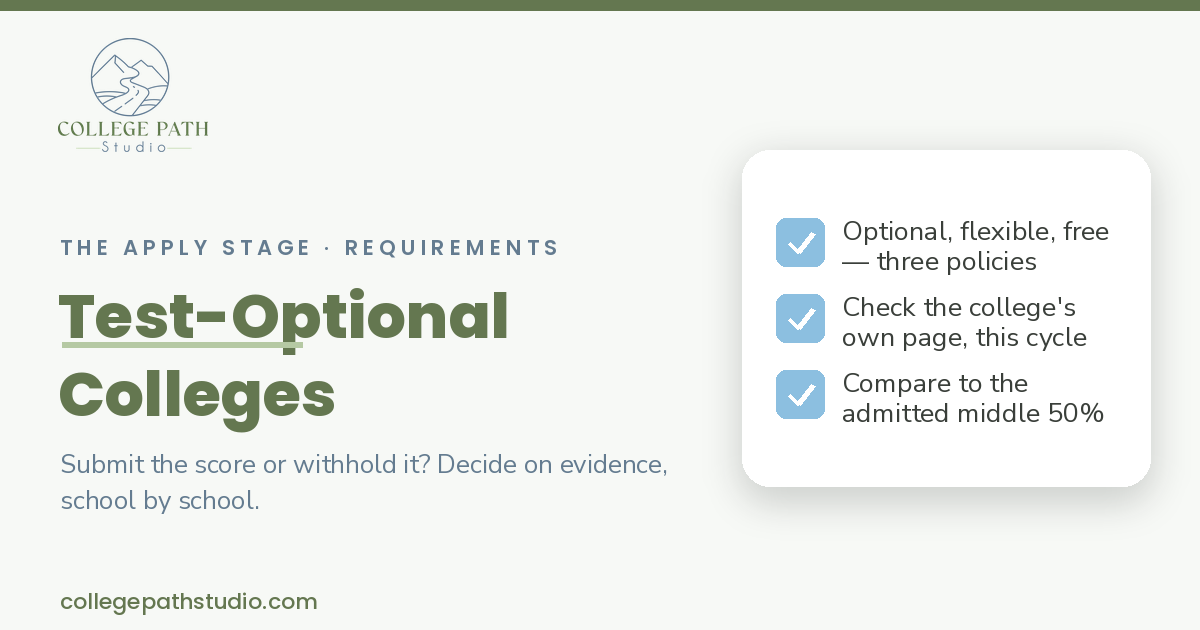
Test-optional means a college will consider an SAT or ACT score if your student sends one, and will not hold its absence against them. It does not mean the score is irrelevant — it means your family now owns a decision the college used to make for you. And the landscape has moved: several highly selective universities have reinstated the requirement outright, so “test-optional” is no longer a safe assumption about any school. Here is how to check, and how to decide.
What does test-optional actually mean?
Get the free College Application Tracker
Every school, deadline and requirement on one page your family can see. Add your first school in ten minutes.
No spam, ever. One toolkit, then the weekly College Path Weekly — unsubscribe any time.
It means the college has two admissions paths and lets the applicant choose which one to walk. Send a score and it becomes part of the file, weighed alongside transcript, rigor, essays, and recommendations. Withhold it and the file is read without it — and the remaining pieces carry proportionally more weight.
That second half is the part families miss. Withholding a score does not remove a data point from the evaluation; it shifts the burden onto everything else. A student with an uneven transcript who withholds a strong score has taken away the one clean piece of evidence in their favor.
So the honest framing is not “do we have to test?” It is: which version of this application is more convincing?
Test-optional, test-flexible, or test-free — what is the difference?
Three distinct policies get collapsed into one phrase, and they call for three different responses.
- Test-optional. Send a score or don’t; the college reads what it receives. The most common policy, and the only one that requires your family to make a judgment call.
- Test-flexible. Some form of testing is expected, but the college accepts substitutes — AP or IB results, A-Levels, or national leaving exams — in place of the SAT or ACT. Read the substitution list carefully; it is narrower than it sounds.
- Test-free (also called test-blind). The college will not look at scores at all, even if sent. The University of California is the clearest example: “UC will not consider SAT or ACT test scores when making admissions decisions or awarding scholarships.” Sending a score to a test-free school accomplishes nothing.
One more category matters and is easy to miss: a college can be test-optional for admission and still require or reward scores for merit scholarships, honors colleges, or direct-admit majors. A student who skips testing entirely can be admitted and still lose money they would have qualified for. Check the scholarship page, not just the admissions page.
Which colleges still require the SAT or ACT?
A growing number, concentrated at the top of the selectivity range. MIT states plainly: “We require the SAT or the ACT for both prospective first year and transfer students,” having reinstated the requirement after its test-optional period. Harvard College likewise “requires the SAT or ACT to meet its standardized testing requirement,” accepting AP, IB, A-Level, or national exam results only where the SAT and ACT are genuinely inaccessible.
Do not build your list from an article listing which schools require what — including this one. These policies change between admissions cycles, and a list published in spring can be wrong by fall. Verify on the college’s own admissions page, for the specific cycle your student is applying in, and write the answer down. That is a fifteen-minute job across ten schools and it is the only version of the answer that is reliable.
Do it once, in August. Doing it in October, one school at a time, while essays are due, is how a requirement gets discovered too late to satisfy.
Should your student submit their score?
Decide school by school, on evidence, not on how your student feels about the number. The same score can be an asset at one college on the list and a liability at another, because the comparison is always against that school’s admitted class.
- Find the school’s middle 50% score range for its most recent admitted class — the 25th and 75th percentiles.
- At or above the 75th percentile: submit. The score is actively helping.
- Between the median and the 75th: submit. A score in the upper half of the admitted range corroborates the rest of the application.
- Below the 25th percentile: withhold. The score will not be read as “close.” It will be read as evidence against, and the application is stronger without it.
- Between the 25th and the median: judgment call. Submit if the score contradicts a weakness — a strong math score against a mediocre math grade, for instance. Withhold if the rest of the file is already the stronger argument.
Two adjustments worth making. First, published ranges at test-optional schools reflect only the students who chose to submit, which skews them upward — treat them as a demanding benchmark rather than an average. Second, if the school reports scores separately for a specific college or program, use that number, not the university-wide one.
Record the decision per school in writing, the same way you record a deadline. “Submit” and “withhold” are answers your family should make once, calmly, in August — not re-litigate at 10 PM the night an application is due.
Where do you find a school’s real score range?
The Common Data Set. Nearly every American college publishes one annually, and Section C contains the enrolled-class score percentiles, the acceptance rate, and how heavily each admissions factor is weighted. Search the college’s name plus “Common Data Set” and open the most recent year.
It is the same document the ranking sites and test-prep companies pull from, published by the college itself and free. Section C7 is particularly worth a look: it states in the college’s own words whether standardized tests are considered “very important,” “important,” “considered,” or “not considered.” That single line often settles the submit-or-withhold question faster than any percentile.
What if your student has not tested at all?
Then the list decides. If every school on it is test-optional or test-free, no testing is required and the application is built on transcript, rigor, essays, and recommendations. If even one school requires a score — or one merit scholarship your family is counting on does — your student needs a test date, and test dates fill.
Settle this in August for the same reason you settle deadlines in August: registration windows close weeks before the test, scores take weeks to arrive, and a required score discovered in October may be impossible to produce before a November 1 deadline. Map the whole calendar first — our college application deadline guide lays out every date the fall contains.
Common questions
Does applying test-optional hurt a student’s chances?
Not by itself. Colleges that adopted the policy read those applications on their merits, and admit students every year who submitted nothing. What hurts is applying test-optional when a strong score was available — that discards evidence for no reason. Judge each school by its range, not by a general rule about whether test-optional “works.”
Can we send a score to one college and withhold it from another?
Yes, and you should. Score reporting is controlled per college, and the whole point of a test-optional landscape is that the decision is per school. A 1380 can sit above the median at one school on your list and below the 25th percentile at another. Same score, opposite decisions, both correct.
Are test-optional policies going away?
At the most selective universities, several have already ended. Across the broader landscape of more than a thousand colleges, test-optional remains widespread. The practical takeaway is not a prediction — it is that “everyone is test-optional now” stopped being true, so every school on your student’s list needs to be checked individually for the cycle they are applying in.
Should a student retake the SAT to get above a school’s median?
Only if the calendar allows it without displacing essays and recommendations, and only if a meaningful gain is realistic. A retake that pushes a score from the 40th to the 60th percentile of an admitted class is worth a fall test date. A retake chasing thirty points at the cost of two supplemental essays is a bad trade — those essays are read at every school on the list.
Your next step
Take your student’s list and answer two questions for every school on it: what is this college’s testing policy for this cycle, and are we submitting? Pull each policy from the college’s own admissions page and each score range from its Common Data Set, and write both answers down beside the school — the free College Application Tracker has a requirements column built for exactly this. Then read how many colleges to apply to to make sure the list itself is balanced, and the college application process for the season end to end.
Get the free College Application Tracker
Every school, deadline and requirement on one page your family can see. Add your first school in ten minutes.
No spam, ever. One toolkit, then the weekly College Path Weekly — unsubscribe any time.