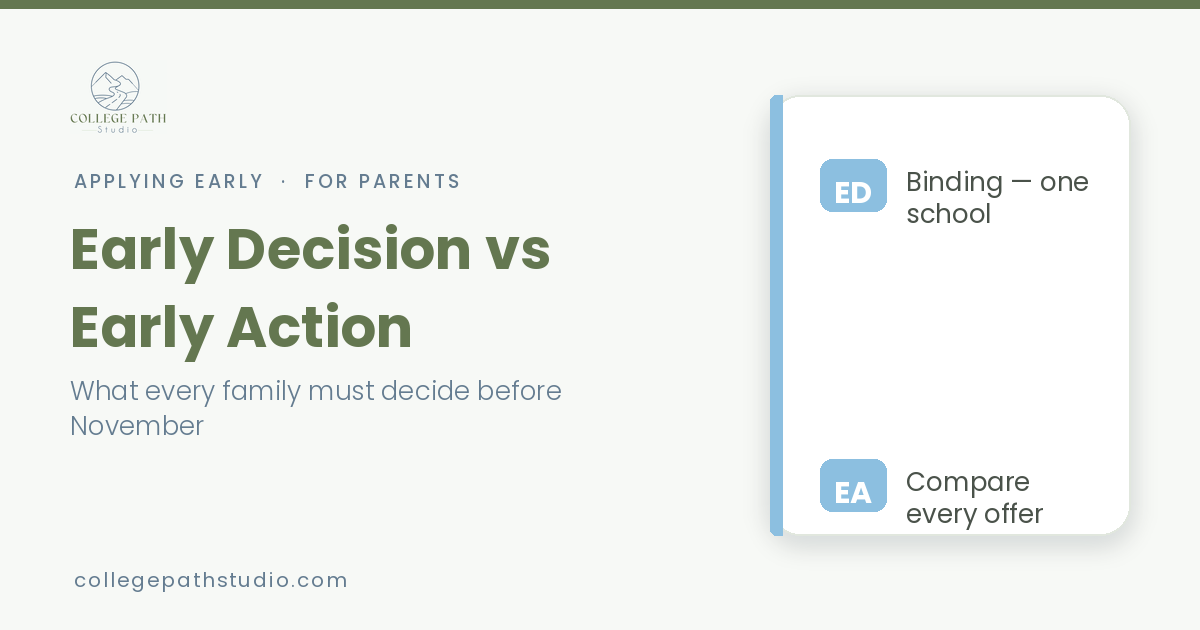
Early Decision is binding: you apply to one school, and if you are accepted, you are committed to attending and must withdraw your other applications. Early Action is non-binding: you apply early to as many schools as you like, get your answers sooner, and keep every option open until May. That is the mechanical difference. The one that matters most to your family is financial — Early Decision asks you to commit before you can compare a single financial aid offer.
Here is how each option works, what it costs you, and how to decide which one fits your family.
What is Early Decision?
Get the free College Application Tracker
Every school, deadline and requirement on one page your family can see. Add your first school in ten minutes.
No spam, ever. One toolkit, then the weekly College Path Weekly — unsubscribe any time.
Early Decision (ED) is a binding commitment. You may apply ED to only one college. If that college admits you, you are obligated to enroll, pay your deposit, and withdraw every other application you have submitted. In exchange, you apply and hear back early — usually a November deadline and a mid-December answer.
Colleges like ED because it locks in students who have named them a clear first choice, which protects their yield. Families are drawn to it because ED acceptance rates often look higher than regular ones. Both of those facts are real. Neither is a reason to apply ED by itself, and we will come back to why.
Many colleges also offer Early Decision II — the same binding commitment, but with a later deadline that usually falls around the regular decision date in January. ED II exists for the student who settles on a clear first choice a little later in the fall. It is every bit as binding as ED I.
What is Early Action?
Early Action (EA) gives you the early timeline without the handcuffs. You apply early, you hear back early, and you are under no obligation to attend. You can apply EA to multiple colleges, sit on your acceptances until the national reply date of May 1, and — this is the part that matters — compare the financial aid offers side by side before you commit a dollar.
For most families, EA is the stronger default. You capture the earlier answer and any admissions benefit while giving up nothing that protects your wallet.
What is Restrictive or Single-Choice Early Action?
A handful of highly selective colleges — Harvard, Yale, Princeton, and a few others — use Restrictive Early Action, also called Single-Choice Early Action. It is non-binding, like regular EA, so you are not committed to attend if admitted. But it restricts where else you may apply early: generally you cannot apply ED or EA to other private colleges in the same round.
The practical effect is that a restrictive early application spends your one early move on a single school. Read each college’s specific rules before you file, because the restrictions vary and the penalty for breaking them is a withdrawn offer.
How do the deadlines compare?
The early calendar is tight and it arrives before most families feel ready.
- ED I and EA: usually November 1, sometimes October 15.
- Decisions: typically mid-December.
- ED II: usually around January, alongside regular decision deadlines.
- Regular Decision: most commonly January 1 through February.
Working backward from a November 1 deadline, essays, recommendations, and testing all need to be finished in October. If your student is applying early anywhere, the fall of senior year is the real deadline — not the spring.
Does applying early actually improve admission chances?
Modestly, and with a caveat that matters. Early acceptance rates do tend to run higher than regular rates. But part of that gap is the applicant pool, not the timing: early pools are full of recruited athletes, legacy applicants, and exceptionally prepared students who skew the numbers. Your individual odds do not jump as much as the headline rates suggest.
Apply early because a college is a genuine first choice and your application is ready, not because you are chasing a statistical edge that is smaller than it looks.
What does Early Decision cost you financially?
This is the section that should drive the decision, and it is the one most families underweight.
When you apply Early Decision and are admitted, you commit before you can see what any other college would have offered. You forfeit your single most powerful financial tool: the ability to compare aid packages and, where colleges compete for the same student, to leverage one offer against another. A family that would have had three offers to weigh in April instead has one, take it or leave it, in December.
For a family that will pay full price regardless, this costs nothing. For a family whose final bill depends on need-based aid or merit money, it can be the difference of tens of thousands of dollars over four years. Before you let your student apply ED anywhere, you need a clear-eyed estimate of what that college will actually cost you.
Run the college’s net price calculator and estimate your Student Aid Index before you commit to an ED application — not after the acceptance arrives. By then the decision is already made.
Can you get out of an Early Decision agreement?
In one specific circumstance, yes. The Common Application’s Early Decision agreement releases a student from the binding commitment if the college’s financial aid package does not meet the family’s demonstrated need. If the aid falls short, you can decline and walk away without penalty.
But read that clause precisely, because families misread it constantly. The escape is tied to demonstrated need — the figure the college calculates from your finances — not to what the price feels like or what you hoped to pay. A college that meets your full demonstrated need has honored the agreement, even if the number is higher than you wanted. “We changed our minds” and “it is more than we budgeted” are not grounds for release. A genuine gap between the aid offered and your calculated need is.
If you reach that point, contact the financial aid office immediately, explain the shortfall, and ask about an appeal before you decline. Aid administrators can sometimes adjust. They cannot help a family that has already walked away in silence.
How should your family choose?
The framework is simpler than the options make it look.
- Choose Early Decision only when two things are both true: the college is your student’s unambiguous first choice, and your family can afford it — either you will pay full price, or the college has a strong record of meeting full demonstrated need.
- Choose Early Action for everything else. It captures the early answer and keeps every financial option open. For most families this is the right default.
- Consider Restrictive Early Action only if a single top-choice college requires it, and only after you have read that college’s specific rules.
If comparing aid offers will shape where your student can afford to enroll — and for most families it will — do not give that power away in a binding ED commitment unless the college is worth the certainty.
Your next step
Before your student applies early anywhere, put a number on the cost. Read what the Student Aid Index means to understand how colleges calculate your aid, work through the FAFSA checklist so your forms are ready for the November crunch, and see the whole sequence in our guide to paying for college. Then download the Parent FAFSA Prep Toolkit and estimate your costs before — not after — you commit to an early plan.
Get the free College Application Tracker
Every school, deadline and requirement on one page your family can see. Add your first school in ten minutes.
No spam, ever. One toolkit, then the weekly College Path Weekly — unsubscribe any time.