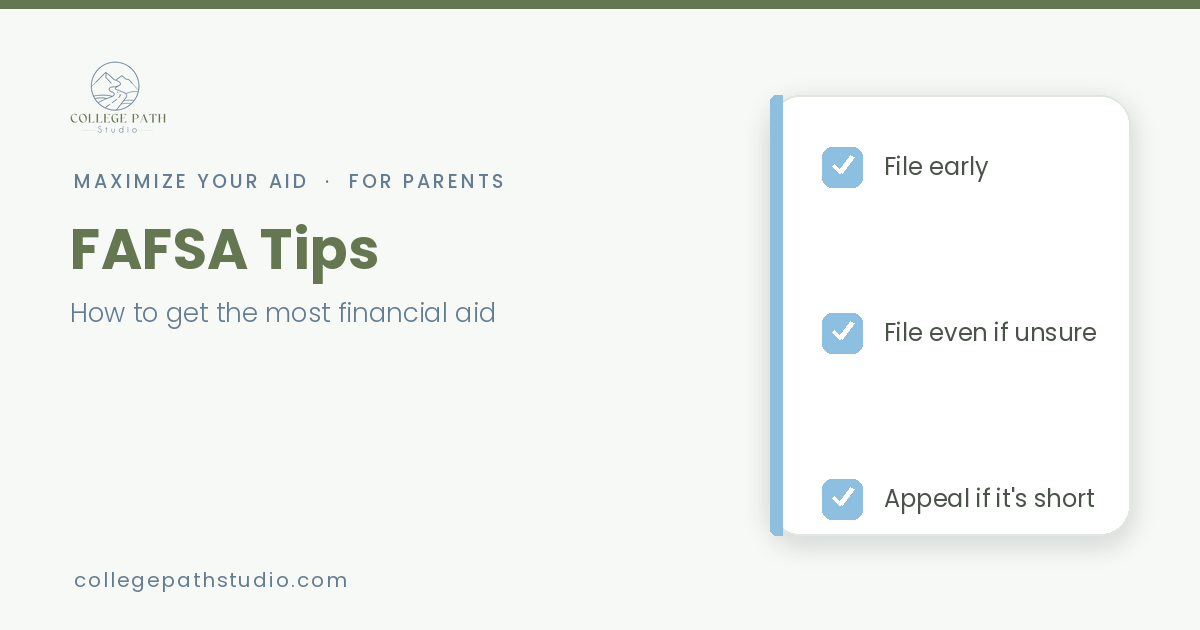
The families who get the most financial aid are rarely the ones with the lowest incomes — they are the ones who file the FAFSA correctly and early. Small mistakes on the form quietly cost real money, and the biggest one is not filing at all. These are the tips that protect your student’s aid, drawn from where families most often go wrong.
If you have not started yet, work through the FAFSA checklist first to gather your documents; these tips are about getting the most from the form once you sit down to it.
When should you file the FAFSA?
Get the Parent FAFSA Prep Toolkit — free
Every account, document, consent step and deadline to have ready before the FAFSA opens. In your inbox in a minute.
No spam, ever. One toolkit, then the weekly College Path Weekly — unsubscribe any time.
The FAFSA opens in October, and a meaningful share of aid is first-come, first-served. State grant programs in several states award funds until the money runs out, and many colleges set priority deadlines months before the federal one. A family that files in October is competing for a full pool; a family that waits until spring is competing for what is left.
The single most valuable FAFSA tip is also the simplest: file in the first few weeks the form is open, not after your taxes are done. The 2027–28 form uses 2025 tax data you already have.
File even if you think you won’t qualify
This is the most expensive assumption in the process. The FAFSA is not only a means test for need-based grants. It is the gateway to unsubsidized federal loans, which are not income-restricted, to work-study, and to a large share of institutional and merit aid that many colleges will not consider a student for without a FAFSA on file. Filing costs you an evening. Skipping it can cost an award nobody told you existed.
Get the contributor and consent steps right
Under the current form, every parent who provides information is a ‘contributor’ who must create their own account, give consent for their tax data to transfer from the IRS, and sign. Without consent from every contributor, your student receives no federal aid at all. This trips up more families than any financial question. Our step-by-step FAFSA walkthrough shows exactly where these steps appear.
Who counts as a parent on the FAFSA?
For divorced or separated families, the required parent is the one who provided the most financial support over the past year — not necessarily the parent the student lives with, and not necessarily the one who claims them on taxes. If that parent has remarried, the stepparent’s income is included too. Getting this right before you start saves a filing from being restarted, and the federal Who’s My FAFSA Parent? wizard settles it in a few minutes.
Don’t report assets you don’t have to
Families routinely over-report and cost themselves aid. These do not count and should never be listed:
- Retirement accounts — 401(k), 403(b), IRA, Roth IRA, and pensions.
- The primary home you live in.
- The cash value of life insurance and annuities.
- ABLE accounts.
Reporting these by mistake inflates your Student Aid Index and shrinks your aid. Know what is reportable before you enter a single number.
Use the right names and the right year
- Names must match the Social Security card exactly. No nicknames, no suffixes. A mismatch causes rejections that take days to fix.
- Use the correct tax year. The 2027–28 FAFSA uses 2025 returns — prior-prior year, not last year’s.
- Report marital status as of the day you file, even if it differs from your tax filing status.
What if you make a mistake after submitting?
Corrections are made by logging back into the form and resubmitting, not by starting a second application — a duplicate creates records that take longer to untangle than the original error. Check the FAFSA Submission Summary against what you entered as soon as it is processed, and fix any discrepancy while it is small. A mistake caught in October is a five-minute correction; the same mistake caught after aid is awarded can cost weeks.
Does the FAFSA affect merit scholarships?
Often, yes — which is another reason to file even if you expect no need-based aid. Many colleges require a FAFSA on file before they will consider a student for institutional merit money, and some state and private scholarships require it regardless of income. The form is not only about demonstrated need; it is the key that unlocks whole categories of aid a family would otherwise never be offered.
Appeal if your circumstances have changed
The FAFSA looks at a tax year that is nearly two years old by the time aid is awarded. If your family’s finances have changed materially since then — a job loss, a medical event, a death — the form cannot see it. But you can tell the college. Contact each financial aid office directly and ask about a professional judgment review. Aid administrators have the authority to adjust your figures for documented changes. They cannot help a family that never asks.
Which FAFSA deadline actually matters?
Three deadlines apply and only the federal one is forgiving. The federal deadline is late and effectively irrelevant; your state’s deadline and each college’s deadline are earlier and control most of the money. Track every college’s aid deadline and work to the earliest. Our guide to paying for college lays out the full financial timeline.
Do you have to file the FAFSA every year?
Yes. The FAFSA covers one academic year, so a student in college refiles every fall for the next year of aid. The good news is that renewals are faster than the first filing — much of your information carries over, and the 2027–28 cycle lets families reuse their details across renewals and across multiple children. Set a recurring October reminder so a year of aid is never lost to a missed refiling.
What about the CSS Profile?
Some colleges — mostly private ones with large institutional aid budgets — require a second form called the CSS Profile in addition to the FAFSA. It asks for more financial detail and produces its own aid calculation, which is why two colleges can look at the same family and offer very different packages. Check whether any school on your student’s list requires it, because it has its own deadlines and its own fee, and missing it can cost institutional aid the FAFSA alone will not unlock.
How do you appeal for more financial aid?
If an aid offer falls short of what your family needs, you can ask the college to reconsider — and more families succeed than expect to. Contact the financial aid office directly, be specific about what changed or what the offer missed, and provide documentation: a layoff notice, medical bills, or a competing offer from a comparable college. Aid administrators have real discretion to adjust, especially for documented changes in circumstance. Be respectful and factual rather than demanding; you are asking a person with authority for help, not disputing a bill. The worst outcome is the offer stays the same, so a well-supported appeal is almost always worth making.
Your next step
Put these into practice before the form opens. Work through the FAFSA checklist to gather everything, review the step-by-step walkthrough so nothing surprises you, and download the College Planning Quick-Start Toolkit to keep your deadlines in one place. File early, file accurately, and file even if you think you won’t qualify.
Get the Parent FAFSA Prep Toolkit — free
Every account, document, consent step and deadline to have ready before the FAFSA opens. In your inbox in a minute.
No spam, ever. One toolkit, then the weekly College Path Weekly — unsubscribe any time.