The 2027–28 FAFSA is open. It opened to everyone on September 23, 2026, and the federal deadline sits nearly two years out. The deadlines that decide whether your family sees a state grant or a polite letter about depleted funds are your state’s and your colleges’, and several of those land before March. Here is the countdown that actually matters, and the work to finish before those dates.
What this guide covers
Get the Parent FAFSA Prep Toolkit — free
Every account, document, consent step and deadline to have ready before the FAFSA opens. In your inbox in a minute.
No spam, ever. One toolkit, then the weekly College Path Weekly — unsubscribe any time.
- When does the FAFSA open for 2027–28?
- Can we file the FAFSA right now?
- Which FAFSA deadline actually matters?
- What happens if we miss a state deadline?
- What is the month-by-month FAFSA countdown?
- What should we do before the form opens?
- Who counts as a contributor?
- How long does the FAFSA actually take?
- What do families get wrong in the countdown?
When does the FAFSA open for 2027–28?
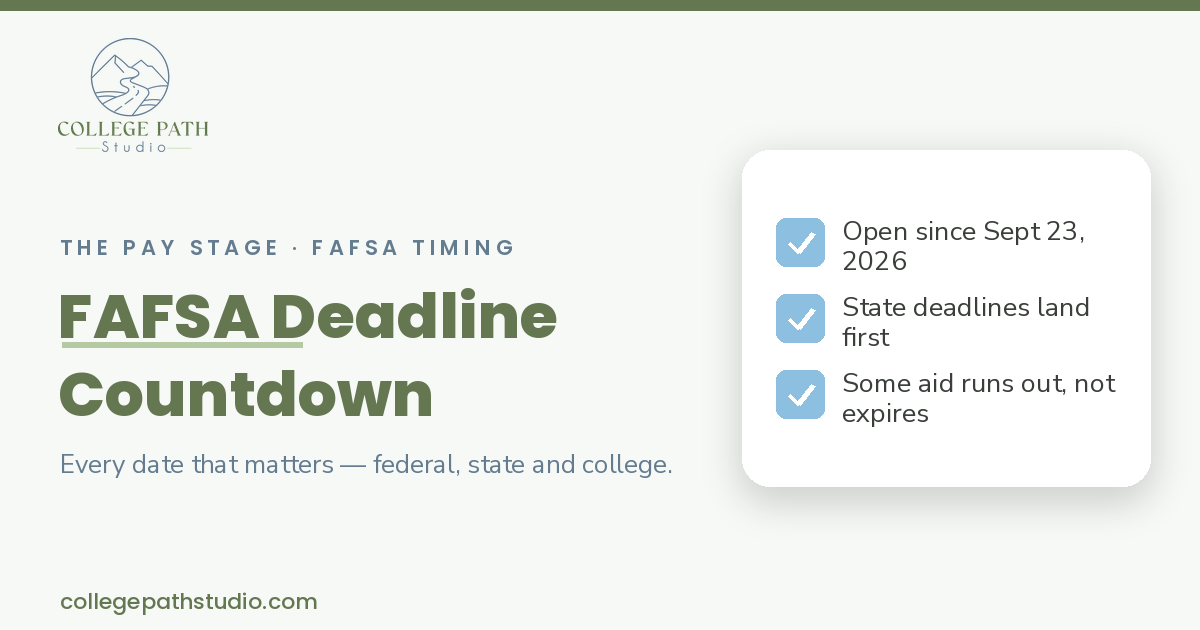
It already has. The 2027–28 FAFSA opened to everyone on September 23, 2026, more than a week ahead of the “by October 1” date Federal Student Aid had promised, and the earliest launch in the program’s history.
That matters if your family lived through the 2024–25 rollout and learned to treat announced FAFSA dates as optimistic. This cycle ran the other way: the form was tested in the open from August, on a published schedule, and released early.
If you have not filed yet, nothing is lost federally. But the state and college clock is already running, and the rest of this guide is about that clock.
Can we file the FAFSA right now?
Yes. The form is open to every family at StudentAid.gov. If you joined the testing phase in August or September and submitted, your form counts, and you do not file again.
Now the honest counterweight, because we would rather you act on the truth than on urgency. Federal Student Aid also says: “There is no advantage or disadvantage to submitting your form early.” Federal aid is not first come, first served. Filing in September does not buy your student a larger Pell Grant.
So why file early? Two reasons, and neither is federal.
First, state and institutional aid frequently is first come, first served. Scroll the state deadline listings and one phrase repeats: awards are made until all funds are depleted. That is a queue, not a deadline, and position in it is worth real money.
Second, the calendar only gets louder. Between now and the early deadlines, your senior is finishing essays, chasing recommendation letters and watching application portals. A task that takes twelve minutes in a quiet week takes a fortnight in a loud one. File this week.
Which FAFSA deadline actually matters?
There are three FAFSA deadlines, and families spend the most attention on the least consequential one.
1. The federal deadline — the latest, and the easiest to hit
The 2027–28 federal deadline is now published. The FAFSA form must be submitted by 11:59 p.m. Central time on June 30, 2028, and any corrections or updates by 11:59 p.m. Central time on September 12, 2028.
Look at that date. You are being asked to worry, in the fall of 2026, about a deadline nearly two years away. That is exactly why the federal deadline is the wrong one to organize your family around — by the time it arrives, every dollar of state and institutional aid for that year has long since been awarded. It is a backstop, not a target.
2. The state deadline — earlier, and where the money quietly disappears
State deadlines are set by each state, they vary enormously, and a meaningful number of them land in the winter. These are the published 2027–28 dates — the cycle your student is actually filing for:
| State | 2027–28 FAFSA deadline | Deadline type |
|---|---|---|
| Texas | January 15, 2027 for priority consideration | Fixed date, very early |
| Missouri | February 1, 2027 priority; accepted through April 1, 2027 | Fixed date |
| Connecticut | February 15, 2027 for priority consideration | Fixed date |
| California | March 2, 2027 for most state aid; Cal Grant GPA due the same day | Fixed date, plus a second document |
| Ohio | October 1, 2027 | Fixed date |
| Illinois (MAP) | As soon as possible after October 1, 2026 | Queue — funds run out |
| Kentucky, Washington, Vermont, North Dakota | As soon as possible after October 1, 2026 | Queue — funds run out |
Look your own state up. The seven rows above are the shape of the calendar, not a substitute for your state’s entry — every state is listed on the official FAFSA Deadlines page, and states do move these dates. Check yours against the source rather than trusting any summary, including ours. A stale date is worse than no date.
Notice the two categories. A fixed date you can put on a calendar. A queue you cannot: “as soon as possible” means the family that files in week one is ahead of the family that files in week six, and no one will ever tell you where the line ended.
3. The college deadline — usually the earliest of the three
Each college sets its own priority date for institutional aid, and it is often the same day as the admission application. Ask every college on your student’s list two questions, and write the answers down:
- What is your priority date for institutional aid?
- Does that date mean the day we submit, or the day you receive our processed FAFSA data?
The second question is not pedantry. Federal Student Aid specifically warns families to ask about it, because processing sits between your submission and the college’s receipt, and a college that measures receipt has effectively moved its deadline earlier than the one it advertises.
Track all of it in one place. Our free College Application Tracker has a column for each college’s aid date next to its admission date, which is where these two calendars belong — together.
What happens if we miss a state deadline?
You file anyway. Immediately.
Federal Student Aid is unambiguous: “Missing a state deadline doesn’t impact your eligibility for federal student aid, so fill out your FAFSA form even if your state deadline has passed.”
A missed state deadline costs you state money. It costs you nothing federal, and it costs you nothing at most colleges. The worst outcome after a missed state deadline is deciding the whole thing is now pointless and skipping the form — which converts a partial loss into a total one.
If your family’s finances changed after you filed — a job loss, a medical event, a death in the family — the deadline is not your remedy. A financial aid appeal is, and it is a separate process with its own timing.
What is the month-by-month FAFSA countdown?
| When | What you do |
|---|---|
| September 2026 | Create StudentAid.gov accounts for the student and every contributor. Settle dependency status. Gather documents. The form opened to everyone on September 23. |
| October 2026 | The form is open to everyone. File now — the queue states are already counting. |
| October–December 2026 | Confirm each college’s priority aid date. File the CSS Profile where it is required. Verify your FAFSA actually processed — do not assume submitted means processed. |
| January–March 2027 | The dense state window. Texas (Jan 15), Missouri (Feb 1), Connecticut (Feb 15) and California (Mar 2) land here. Confirm your own state’s date on the official page. |
| Spring 2027 | Aid offers arrive. Compare them side by side, not one at a time. Appeal where circumstances warrant it. |
| Through June 30, 2028 | The federal backstop. Submissions close 11:59 p.m. CT on June 30, 2028; corrections close September 12, 2028. If you are relying on this date, the state and college money is already gone. |
What should we do before the form opens?
Five things. Each takes minutes now and saves hours in October.
Create the StudentAid.gov accounts — all of them
Your student needs an account. So does every contributor. They are separate accounts and they cannot be shared. Account verification is the single most common source of October delay in our experience, because it is the one step that depends on someone else’s systems responding. Do it first, and do it this month.
Settle dependency status
Dependency status determines whether a parent’s information is required at all. Federal Student Aid provides a determination tool; use it rather than assuming, because the federal definition does not track who claims whom on a tax return.
Identify which parent is the contributor
For dependent students, use the official Who’s My FAFSA Parent? wizard. For families with divorce, remarriage, or shared custody in the picture, this answer is genuinely not intuitive, and it is the wrong thing to discover at eleven o’clock the night before a state deadline.
Gather the documents
Pull them into one folder now. Our guide to the documents needed for the FAFSA lists exactly what each contributor brings.
Decide whether you also file the CSS Profile
Some colleges require a second form with a separate deadline and a fee. Work out whether yours do before October, using our comparison of the CSS Profile and the FAFSA.
Who counts as a contributor, and why does it stall families?
A contributor is anyone required to provide information on the form — typically the student and one or both parents. Federal Student Aid states two things about them that families get wrong in opposite directions.
The first: “You can’t qualify for federal student aid without their participation.” A contributor who declines to complete their section does not slow the form down. They stop it.
The second, and this is usually the reason for the first: “Adding their information to your form doesn’t make them responsible for paying for your school costs.”
That fear is the quiet blocker behind a great many unfinished FAFSAs, and it is unfounded. Have the conversation in September, while it is a calm conversation.
How long does the FAFSA actually take?
Federal Student Aid reports that “people typically finish their section of the FAFSA form in 12 minutes or less.”
Twelve minutes. The form is not the work — the preparation is. Families who spend an hour in September creating accounts and gathering documents spend twelve minutes in October filing. Families who skip September spend October on hold with a help line.
When you are ready to sit down with it, our step-by-step FAFSA walkthrough takes you through the form section by section, and our explainer on the Student Aid Index covers what the number at the end actually means.
What do families get wrong in the countdown?
- Treating the federal deadline as the deadline. It is the last one and the least consequential. Your state’s and your colleges’ dates are the ones with money attached.
- Assuming you earn too much to bother. Federal Student Aid’s own guidance is that the form is for “any student, regardless of income, who wants to be considered for federal, state, and school financial aid programs.” Institutional aid and some scholarships require it whatever your income. Filing costs you nothing but the twelve minutes.
- Letting one parent do it alone when a second contributor is required. The form will not complete.
- Confusing submitted with processed. Check back and confirm the form processed. A submission sitting in an error state is invisible until a college tells you it never arrived.
- Waiting for a quieter month. There is not one. October is louder than September, and November is louder than October.
Your next step
Do the September work before the form opens, and October becomes a twelve-minute task instead of a three-week scramble.
Get the FAFSA Prep Toolkit — the account setup, contributor decisions, and document list in one professional checklist you can work through this week, before the 2027–28 form opens to everyone.
For the wider financial aid picture — forms, timing, and what colleges do with your numbers — start at our Paying for College hub.
Get the Parent FAFSA Prep Toolkit — free
Every account, document, consent step and deadline to have ready before the FAFSA opens. In your inbox in a minute.
No spam, ever. One toolkit, then the weekly College Path Weekly — unsubscribe any time.