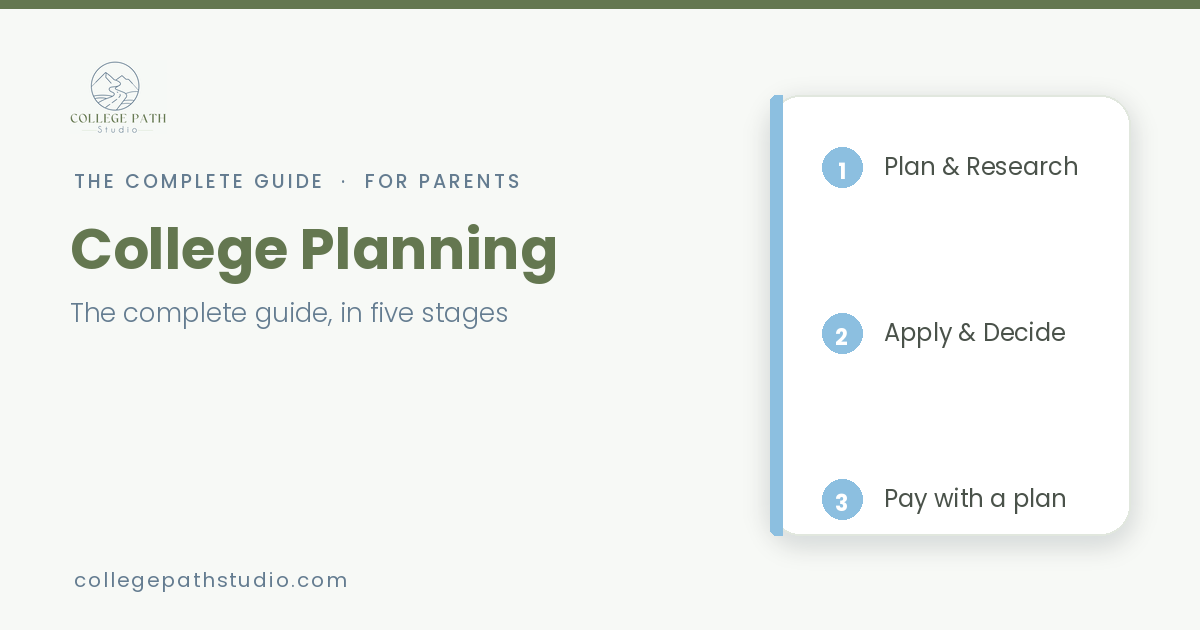
College planning is the multi-year process of preparing your student academically, choosing where to apply, submitting strong applications, and paying for it all without taking on more debt than a family should. It sounds enormous. Broken into stages and started early, it is entirely manageable — and you do not need an expensive private counselor to do it well.
This guide is the whole map. It walks through the five stages of college planning, shows what matters at each one, and links to the detailed workflow for every step. Wherever your student is, start with the stage in front of you.
What is college planning?
College planning is everything that happens between a student first thinking about college and the day they enroll. It covers the courses they take, how they spend their time outside class, the colleges they choose, the applications they submit, and how the family pays. Done as a scramble in senior year, it is stressful and expensive. Done as a steady process over several years, it becomes a series of small, well-timed decisions.
The families who navigate it best are not the ones who spend the most. They are the ones who start early, understand the sequence, and keep the student in the driver’s seat. That is the entire premise of doing this yourself with the right framework: you have the capability; what most families lack is the map.
When should college planning start?
The honest answer is that earlier is easier, but any starting point works. A student who begins building rigor and habits in 9th grade has the smoothest path, because the transcript — the single most important part of an application — is written over four years and cannot be rewritten late. But a family starting in junior or even senior year still has full control over the application itself: the college list, the essays, the recommendations, and the financial aid forms.
Start where you are. Our grade-by-grade college planning checklist shows exactly what to do at each grade, and our guide to planning for college in high school explains the strategy behind those tasks.
The five stages of college planning
Every family’s path runs through the same five stages. Each has its own decisions, its own deadlines, and its own detailed guide.
1. Plan
The academic and strategic groundwork — course rigor, grades, and depth of involvement in a few activities. This is the foundation the whole application rests on. Start with the Plan stage and the planning checklist.
2. Research
Choosing where to apply. A balanced, affordable list of eight to twelve colleges across reach, match, and safety — where every option is one your family could actually pay for. See how to build a college list.
3. Apply
Submitting applications, on time and without errors. This is where the Early Decision vs Early Action choice matters, because it can commit your family before you can compare financial aid.
4. Decide
Comparing acceptances and, crucially, comparing aid offers. The most expensive mistake in the whole process is committing to a college before seeing what it will actually cost after aid.
5. Pay
Financial aid, the FAFSA, scholarships, and loans. Start with the Pay stage, complete the FAFSA, and understand the Student Aid Index that determines your aid.
What do colleges actually look for?
Across all of this, colleges weigh a handful of factors, and not equally. Course rigor and the trajectory of grades carry the most weight, followed by depth of involvement in a few activities, then essays and recommendations — with test scores mattering again at a growing number of selective colleges. Understanding this is what turns four years of guesswork into a strategy, which we cover in detail in our guide to what colleges look for.
How much does college planning cost?
It can cost almost nothing, or tens of thousands of dollars — and the difference is mostly about who does the work. A private college counselor runs $100 to $300 an hour or $3,000 to $15,000 per package. Most of what they provide, though, is structure and information a motivated family can assemble itself. The tools are largely free; what families lack is a framework that says which tool to use when.
That framework is exactly what our college planning tools and Professional Toolkits provide — the expertise of a counselor, packaged into workflows you run yourself, at a fraction of the cost.
What is the parent’s role in college planning?
Your role is architect, not laborer. You hold the structure — keep the timeline visible, ask the questions that prompt decisions, manage the financial planning, and make sure deadlines do not slip. The work itself, the courses and activities and essays, has to belong to the student. Colleges can tell when an application was written by a parent, and a student who owns the process is the one who thrives once they arrive on campus. The families who do this best provide the framework and let the student build within it.
What are the most common college planning mistakes?
- Starting in junior or senior year, after the transcript is largely written.
- Chasing a long list of activities instead of depth in a few genuine interests.
- Building a college list on prestige rather than fit and affordability.
- Committing to a college — especially through Early Decision — before comparing aid offers.
- Treating the federal FAFSA deadline as the real one, when state and college deadlines come far earlier.
- Letting the parent do the work rather than hold the timeline, producing applications that do not sound like the student.
Every one of these is avoidable, and none requires money to avoid. They require starting early and keeping the student in charge of the work.
Common questions about college planning
Do you need a private college counselor?
For most families, no. A counselor earns their fee for students with complex profiles or families with no time to manage the process. For everyone else, the real need is a framework and the discipline to follow it. We lay out the honest case both ways in our guide to whether a college counselor is worth it.
How do you choose the right college?
Fit first, then affordability. The best college is not the highest-ranked one; it is the one where your student will thrive, graduate, and not be buried in debt. Match size, setting, academic strengths, and cost to your student — and make sure every school on the list is one they would be genuinely happy to attend.
What is the first step?
Identify your student’s stage and do that stage’s work. If they are in 9th or 10th grade, focus on rigor and involvement. If they are a junior, build the list and start the financial conversation. If they are a senior, execute the applications and file the aid forms on time.
Your next step
Begin with the Plan stage and work the grade-by-grade checklist. Then download the College Planning Quick-Start Toolkit to bring the whole plan together in one place. College planning is only overwhelming when you try to see all of it at once — so start with the single step in front of you.