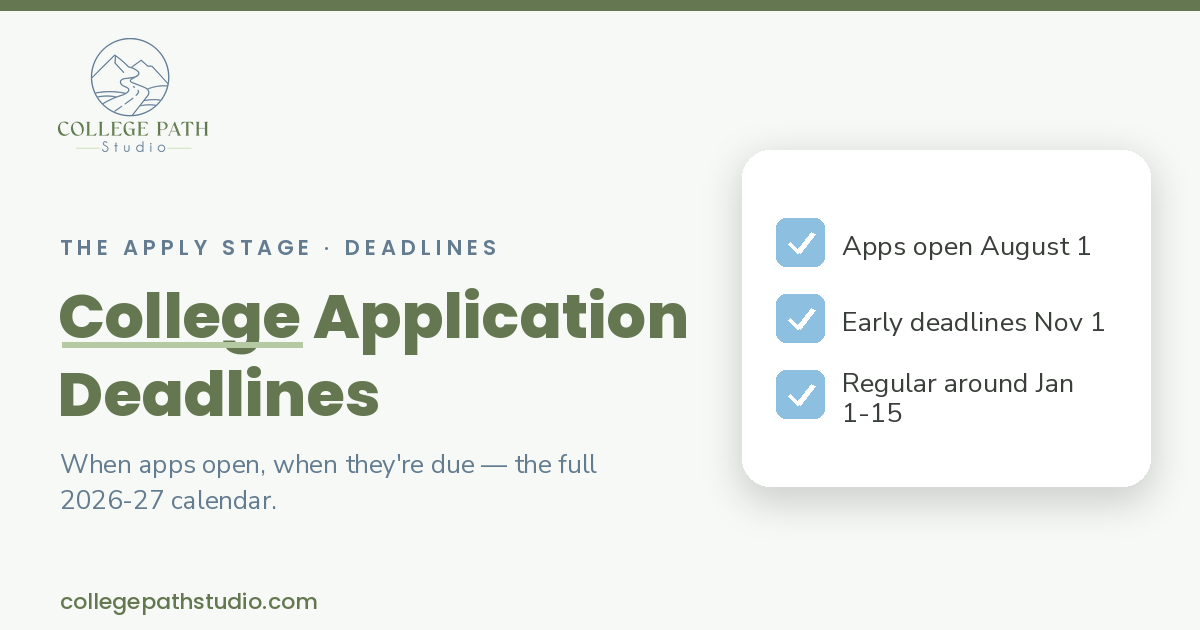
College applications for students entering in fall 2027 open on August 1, 2026, and the earliest deadlines land on November 1. Between those two dates sits the most deadline-dense stretch of senior year — a wall of Early Decision, Early Action, Regular Decision, financial-aid, and portfolio dates that don’t move and don’t forgive. This is the full calendar, plus how to keep every date straight so none of them sneaks up on your family.
Get the free College Application Tracker → and put every deadline in one place before the season starts.
When do college applications open?
Get the free College Application Tracker
Every school, deadline and requirement on one page your family can see. Add your first school in ten minutes.
No spam, ever. One toolkit, then the weekly College Path Weekly — unsubscribe any time.
The Common Application opens August 1, 2026 for the 2026–27 cycle, with more than 1,100+ member colleges, and most other platforms open around the same time. That’s the starting gun. Applications are available for months before they’re due — and the families who move through the fall calmly are the ones who start building their list and their essays in August, not October.
Opening day is not a deadline. It’s your runway. Use it.
What are the college application deadline types?
Colleges don’t share one deadline — they offer several application “plans,” each with its own date and its own rules. Your student will likely mix them across their list:
- Early Action (EA) — apply early, get an answer early, non-binding. No obligation to attend.
- Early Decision (ED) — apply early, binding. If admitted, your student must withdraw all other applications and enroll. Only one ED school allowed.
- Restrictive Early Action (REA) — non-binding, but bars applying early to other private schools.
- Early Decision II (ED II) — a second binding round, usually with a January deadline, for students whose top choice comes into focus later.
- Regular Decision (RD) — the standard, later deadline.
- Rolling admission — no single deadline; the school reviews applications as they arrive until the class fills.
The binding-vs-non-binding difference is the highest-stakes call of the season. We break it down in Early Decision vs Early Action.
When are Early Decision and Early Action due?
For most selective colleges, Early Decision and Early Action deadlines fall on November 1, with a smaller set on November 15 (and a few as early as October 15). Decisions from these early rounds typically arrive in mid-December.
Because the early rounds hit first and hardest, work backward from November 1 as your anchor. Everything your student needs for an early application — essays, recommendation letters, transcripts, test scores — has to be finished weeks earlier, not the night before.
When is the Regular Decision deadline?
Regular Decision deadlines cluster between January 1 and January 15, 2027, at most selective schools, with decisions arriving March through April. After that comes the one deadline that runs in your family’s favor: May 1 — National Decision Day, the date by which admitted students commit. That’s your window to compare offers before you choose.
What about rolling admissions and state systems?
Two categories break the usual pattern:
- Rolling admission schools accept applications until the class is full, so earlier is genuinely better — spots and aid shrink as the cycle goes on.
- State university systems often run one application for all their campuses on a single deadline, including the University of California application, Cal State Apply, and ApplyTexas. Note that some open and close on a different schedule than the Common App, so confirm each system’s dates directly.
Don’t forget the financial aid and portfolio deadlines
Two deadlines families routinely miss because they sit outside the application itself:
- Financial aid. The The 2027–28 FAFSA opened September 23, 2026, and state and institutional aid deadlines often come earlier than the application deadlines — with much of the money awarded first-come, first-served. Treat aid as part of applying, not a task for later. Our FAFSA checklist keeps it on track.
- Portfolios and auditions. Students applying to arts, music, dance, or performance programs often face separate, earlier deadlines to submit pre-screens or portfolios — sometimes weeks before the school-wide application is due.
Why deadlines are the one part of this process with no appeal
Universities post their confirmed deadlines in August and hold to them. Miss one, and there is no second chance — admissions offices don’t grant extensions, because they published the date months in advance. That single fact is why organization matters more than anything else in the Apply stage: the hardest part isn’t any one application, it’s managing all of them against a wall of overlapping dates.
How do you keep every deadline straight?
You put them in one place. A dozen schools, each with a different plan, deadline, platform, and set of requirements, cannot live in your head or across a stack of browser tabs.
Our free College Application Tracker gives your family one row per school — deadline, admission plan, platform, requirements, and a live status column — so the whole calendar sits in front of you at a glance. See how this stage fits the full journey in our guide to the college application process.
How do you build a deadline plan that holds?
Work backward from the earliest date on your list. If your student is applying anywhere Early Decision or Early Action, November 1 is your anchor — and everything an application needs has to be ready before it. Ask teachers and your counselor for recommendation letters at least a month out (they’re writing dozens each fall), confirm how your high school sends official transcripts, and start essay drafts in August, because finding the idea takes far longer than writing it. Then log every school’s plan and deadline in one place so the whole calendar is visible at once. Build in a buffer, too — aim to finish each application a week before its deadline, so a last-minute portal glitch or a missing transcript never costs you the date. A deadline you can see is a deadline you can hit.
Common questions about college application deadlines
Can you apply Early Decision to more than one school?
No. Early Decision is a single, binding commitment — your student can apply ED to only one college. You can pair that one ED application with non-binding Early Action elsewhere, but check each school’s rules, because some early plans (like Restrictive Early Action) limit where else you may apply early.
What happens if you miss a college application deadline?
In most cases the application simply won’t be considered — there’s no appeal, because the date was published months ahead. If it happens, your options are schools with rolling admission that are still open, a later round like Early Decision II or Regular Decision, or applying in the next cycle. The fix is never an extension; it’s a backup plan.
Is it better to apply early?
Often, yes — early rounds can offer a small admissions edge and get an answer back by December, and rolling-admission schools fill seats and aid as they go. But only apply early when the application is genuinely ready; a rushed early application helps no one. And never apply Early Decision unless your family is certain of the school and confident you can afford it without comparing offers.
Do college application deadlines change every year?
The structure is stable — applications open around August 1, early deadlines cluster on November 1, and Regular Decision lands in early-to-mid January. But the exact dates shift slightly each cycle and vary by school, so confirm every date on the college’s own admissions page rather than trusting last year’s number.
Your next step
Don’t let a deadline be the reason a school falls off your student’s list. Get the free College Application Tracker → and map every date this week — while August is still your runway.
Get the free College Application Tracker
Every school, deadline and requirement on one page your family can see. Add your first school in ten minutes.
No spam, ever. One toolkit, then the weekly College Path Weekly — unsubscribe any time.