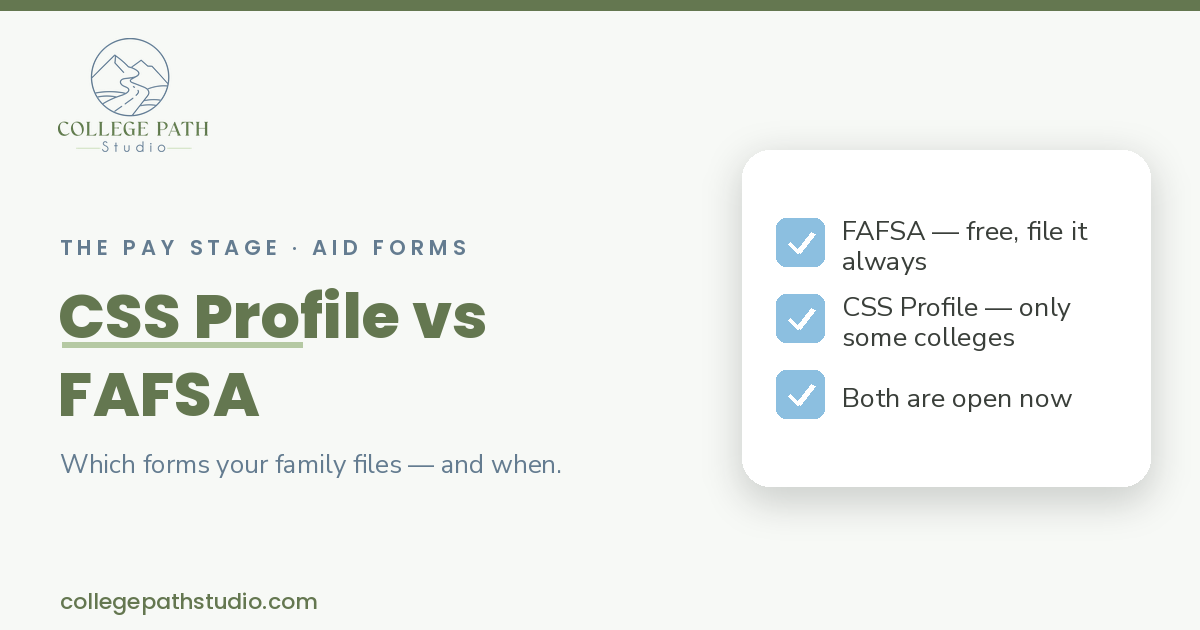
Every family applying for college financial aid should file the FAFSA — it is free, federal, and nearly every college in the country uses it to award aid. The CSS Profile is a second, separate application from the College Board, and only certain colleges — mostly private and highly selective — require it. It costs money, asks deeper financial questions, and can produce a different aid number than the FAFSA. Which forms your family files comes down to one thing: your college list. You file the FAFSA every time. You add the CSS Profile only when a school on your list requires it.
Here is exactly how the two forms differ, who needs which, and how to file both without losing aid to a missed deadline or a form you didn’t know you had to submit.
What’s the difference between the CSS Profile and the FAFSA?
Get the Parent FAFSA Prep Toolkit — free
Every account, document, consent step and deadline to have ready before the FAFSA opens. In your inbox in a minute.
No spam, ever. One toolkit, then the weekly College Path Weekly — unsubscribe any time.
The FAFSA — the Free Application for Federal Student Aid — is run by the U.S. Department of Education. It is the gateway to federal aid (Pell Grants, federal student loans, and work-study), to state aid, and to the need-based aid at nearly every college. It is free, and every family should file it.
The CSS Profile is run by the College Board — the same organization behind the SAT. Close to 400 colleges, universities, and scholarship programs use it, and the list skews heavily toward private and highly selective schools. Those colleges use it to award their own institutional grant money, on top of federal aid. The Profile costs money, asks for far more financial detail, and lets each college interpret your numbers its own way.
| FAFSA | CSS Profile | |
|---|---|---|
| Run by | U.S. Department of Education | College Board |
| Cost | Free, always | $25 for the first college, $16 each additional (waivers available) |
| Who uses it | Nearly every college, all states, federal aid programs | Close to 400 mostly private, selective colleges and scholarship programs |
| Aid it unlocks | Federal aid, state aid, and most college need-based aid | The college’s own institutional grant aid |
| How need is figured | Federal Methodology → your Student Aid Index (SAI) | Institutional Methodology — each school decides |
| What it counts | Income and assets; excludes your primary home and retirement | Digs deeper: home equity, the non-custodial parent, medical costs, and more |
The short version: the FAFSA is the universal, free baseline. The CSS Profile is an extra, paid, more detailed form that a specific set of colleges layer on top to hand out their own money. For a full breakdown of the federal number the FAFSA produces, read what the Student Aid Index means for your family.
Who has to file the CSS Profile?
Your college list decides this, not your income. If a school on your list requires the CSS Profile, you file it; if none do, you skip it entirely and file only the FAFSA. The colleges that require it are overwhelmingly private and selective — think the Ivies, the “little Ivies,” and well-funded liberal arts colleges that award large institutional grants. Most public universities do not use it.
Do not guess. Check each college’s financial aid page, or the College Board’s participating-institutions list, and write down which of your schools require the Profile and which want it only from certain applicants. Two rules hold no matter what you find: you always file the FAFSA, and you file the CSS Profile only for the specific colleges that ask for it.
What does the CSS Profile ask that the FAFSA doesn’t?
This is where families get surprised. The CSS Profile reaches into corners of your finances that the FAFSA leaves alone, which is why the same family can look needier on one form than the other. The three differences that move the most money:
- Home equity. The FAFSA never counts the value of the home you live in. The CSS Profile asks for it — and colleges treat it differently: some assess the full equity, some cap it at a multiple of your income, and some ignore it. If you own your home, you can show more need on the FAFSA than on the Profile.
- The non-custodial parent. For divorced or separated parents, the FAFSA looks at the one parent who provided the most financial support over the past year. Many CSS Profile colleges require the other parent to file a separate Noncustodial Profile — so both parents’ finances count.
- The finer print. The Profile also asks about medical and dental expenses, the value of a family business or farm in more detail, expected summer earnings, and other assets the streamlined FAFSA skips.
None of this is about hiding money — it is about knowing which form asks what, so nothing catches you off guard and every number you report is accurate. When you’re ready to gather the paperwork, our checklist of documents needed for the FAFSA covers the shared foundation both forms draw from.
How much does the CSS Profile cost, and can the fee be waived?
The FAFSA is free — the word “Free” is in its name, and paying to file it is always a sign you’re on the wrong site. The CSS Profile charges $25 for the application and your first college, then $16 for each additional college you send it to.
Many families pay nothing. The College Board automatically waives the fee for domestic students whose family adjusted gross income is roughly $100,000 or less, for students who received an SAT fee waiver, and for applicants who are orphans or wards of the court under 24. About 40% of students file the Profile for free. The waiver is applied for you when you qualify — there is no separate form to chase.
When are the CSS Profile and FAFSA due?
Both 2027–28 forms are open now: the FAFSA opened September 23, 2026, and the CSS Profile is available too. From here, their deadlines work very differently, and the CSS Profile is the less forgiving of the two.
- CSS Profile deadlines are set by each college and cluster around that school’s application deadlines — often November 1 for Early Decision or Early Action, and January or February for Regular Decision. Miss a college’s Profile deadline and you can lose its institutional aid, even if your FAFSA is in.
- The FAFSA’s federal deadline is a distant backstop (late June after the school year starts), but colleges and states set their own priority deadlines far earlier, and some state aid runs out first-come, first-served.
The safe move is to treat October as filing season and submit both forms as early as you reasonably can. Filing early never costs you aid; filing late can.
Which form should your family file?
Work it in this order:
- File the FAFSA — every family, every year. It is free, it is required for federal and state aid, and nearly every college uses it. There is no scenario where skipping it helps you.
- Check each college on your list for the CSS Profile. Look at every school’s financial aid page and note which require it. Mostly private, selective colleges will; most public universities won’t.
- If any school requires the Profile, file it — and mind its earlier deadline. Gather the extra details it asks for (home equity, the non-custodial parent, medical costs) so a second form doesn’t become a second scramble.
The families who handle this calmly are the ones who sorted out which forms they owed before October and gathered the paperwork once, in advance. That preparation is entirely within your control — the tax information both forms ask about is already filed, so there is nothing to wait on.
Your next step
Before you open either form, get your documents in one place so you can file in a single sitting. Download the free FAFSA Prep Toolkit for the exact accounts, records, and logins to gather, then walk the process with our step-by-step guide to how to fill out the FAFSA. If you’re mapping your family’s full aid picture, start at the paying for college hub. File the FAFSA first, add the CSS Profile where your colleges require it, and you’ll have both forms handled before the season even peaks.
Get the Parent FAFSA Prep Toolkit — free
Every account, document, consent step and deadline to have ready before the FAFSA opens. In your inbox in a minute.
No spam, ever. One toolkit, then the weekly College Path Weekly — unsubscribe any time.