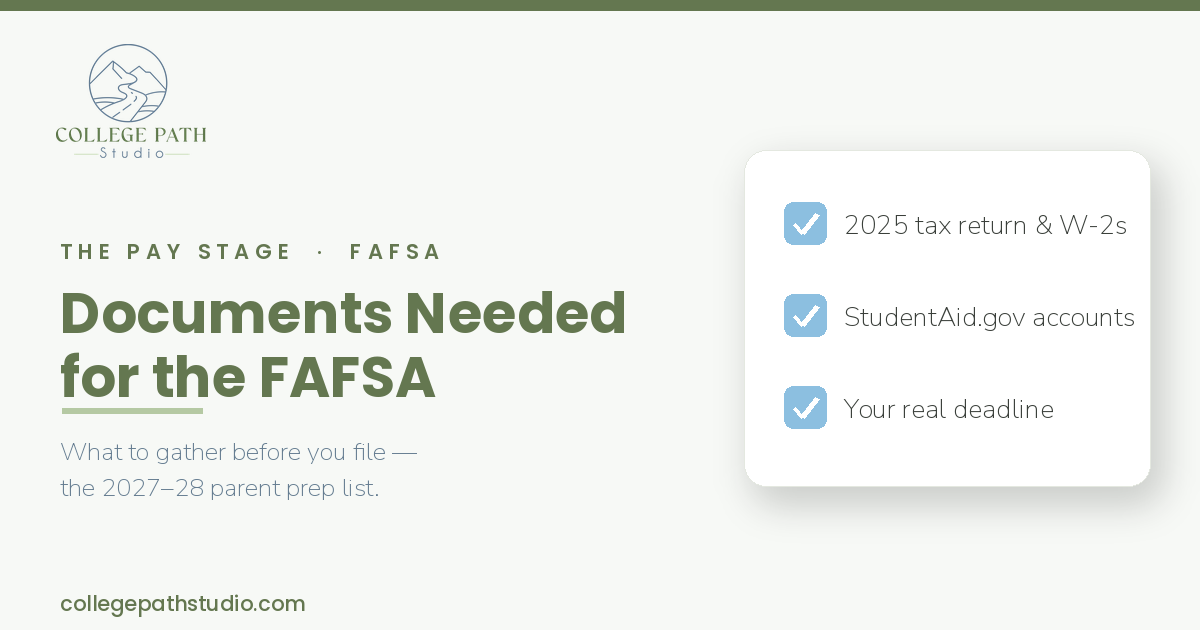
Before you open the 2027–28 FAFSA, gather these: your student’s Social Security number, a StudentAid.gov login for every contributor, your 2025 federal tax return and W-2s, records of any child support received, current balances of your cash and bank accounts, and the net worth of any investments or family business. That is the short list. Families who pull it together in advance file in one sitting; the ones who don’t spend weeks chasing paperwork with the form half-finished. Below is every document and detail you need, whose information counts, and — just as important — what you should leave off.
What documents and information do you need for the FAFSA?
Get the Parent FAFSA Prep Toolkit — free
Every account, document, consent step and deadline to have ready before the FAFSA opens. In your inbox in a minute.
No spam, ever. One toolkit, then the weekly College Path Weekly — unsubscribe any time.
The FAFSA asks for identity, income, and assets — for the student and for every parent who counts as a contributor. Pull these together before you start, and the form becomes data entry instead of a research project:
- Your student’s Social Security number, entered exactly as it appears on the card.
- A StudentAid.gov account for the student and for each contributing parent (more on who that is below).
- Your 2025 federal tax return, W-2s, and records of any money earned from work in 2025.
- Records of child support received during the year.
- Current balances of cash, checking, and savings accounts — the value on the day you file, not an average.
- Net worth of investments, including brokerage accounts, 529 plans you own, and real estate that is not your primary home.
- Net worth of a family business or income-producing farm, if you have one.
- If a parent is married, that spouse’s date of birth and email address.
Two things trip families up here. First, the FAFSA uses 2025 tax information, not 2026 — it reports prior-prior-year income, so there is nothing to wait for and no reason to delay filing until next spring’s return is done. Second, “assets” means balances as of the day you submit, so it is worth gathering these close to when you actually file rather than months ahead.
Whose information do you need — who counts as a contributor?
A contributor is anyone whose information is required on the form: the student always, plus one or both parents depending on your family’s situation. Every contributor needs their own StudentAid.gov account and has to provide consent for their tax data to transfer in. Figuring out who your contributors are — before anyone starts an account — saves the single most common source of mid-form panic.
- Married, filed jointly: one parent is the contributor. You will still need your spouse’s date of birth.
- Married, filed separately: both parents are contributors, and each needs a separate account.
- Divorced or separated: the contributor is the parent who provided the most financial support over the last 12 months — not necessarily the one the student lives with. The federal “Who’s My FAFSA Parent?” wizard confirms it.
- A parent without a Social Security number: still a contributor. They can create an account and complete their section, and it does not affect the student’s eligibility.
The rule that costs families real aid: every contributor must consent to the IRS data transfer. If even one contributor withholds consent, the student receives zero federal aid — not a reduced amount, none. Giving consent does not make you responsible for paying anything; that only begins if you later choose a Parent PLUS Loan.
What do special financial situations change?
Some families need a little more than the standard document list. If any of these describe you, gather the extra pieces now:
- Self-employed or a business owner: alongside your 2025 return, have your Schedule C or business return and a current figure for the business’s net worth. Self-employment income and business value are both reported.
- Divorced or separated: only the contributor parent’s information goes on the form, but keep documentation of who provided the most support over the last 12 months in case a college’s aid office asks.
- A contributor without a Social Security number: they create an account using their own identity details and complete their section normally — it does not reduce the student’s federal aid.
And if your family’s finances have changed sharply since 2025 — a job loss, a drop in income, a major medical expense — file with the 2025 figures anyway, then contact each college’s financial-aid office about a special circumstances review. Aid offices can adjust an offer for a situation the prior-prior-year data cannot see, but only after you have filed.
What should you NOT report on the FAFSA?
Knowing what to leave off is worth as much as knowing what to include, because over-reporting quietly inflates what a family looks able to pay and shrinks the aid offered. Do not report:
- Retirement accounts — 401(k), 403(b), IRA, Roth IRA, and pensions.
- The primary home you live in — its value is never a FAFSA asset.
- The cash value of life insurance and annuities.
- ABLE accounts for a beneficiary with a disability.
One recent change is easy to miss: as of the 2024–25 form, every family business and farm is reportable regardless of size — the old exemption for small businesses is gone. The one carve-out that remains is that a farm’s primary dwelling is still excluded. If a competitor’s older guide tells you a small business is exempt, it is out of date.
How do you report assets and investments without over-reporting?
Assets are where careful families accidentally hand back aid, because the FAFSA asks for values in a specific way. Report the balance or net worth on the day you file — not a yearly average, and not the highest it ever reached. A few points that matter:
- 529 college-savings plans: a plan owned by the parent or the student is a parent asset. A plan owned by a grandparent or other relative is not reported at all — a meaningful distinction if extended family is saving for your student.
- Investment real estate: a rental or second property is reported at net worth — market value minus what you owe on it. Your primary home is never included.
- Cash and bank balances: use the actual number on submission day, so it is worth paying a routine bill before you file rather than after.
- Business or farm net worth: value minus debt. Since every business and farm is now reportable, have that figure ready from your books or your accountant.
None of this is about hiding money — it is about reporting the right number, in the right category, on the right day, so your family’s picture is accurate rather than inflated.
When did the 2027–28 FAFSA open, and which year’s taxes does it use?
The 2027–28 FAFSA opened on September 23, 2026, and it uses 2025 tax information. That prior-prior-year design is deliberate: the taxes it asks about are already filed, so preparation is entirely within your control before you log in. There is no waiting on paperwork — only gathering it.
Filing early matters more than families expect. Three deadlines apply, and only one is forgiving: the federal deadline is a distant backstop (the money is long gone before it arrives), but many state aid programs award funds first-come until they run out, often with deadlines as early as February, and individual colleges frequently set priority financial-aid deadlines in January or February. Your real target is the earliest date on your student’s college list. Gathering everything now is what lets you file in the first couple of weeks and beat those first-come funds running dry.
How do you set up the StudentAid.gov accounts before you file?
This is the step that derails the most families, and it has nothing to do with money. Each contributor creates their own account at StudentAid.gov, and new accounts sometimes take a day or more to verify against Social Security records — which is exactly why you do it now, not on filing day. A few rules to get right:
- Your student creates their own account. You cannot make it for them and you cannot share yours — the login is a legal signature, and sharing it invalidates the form.
- Each contributor uses their own email address, not a shared one. Two accounts on one email will collide.
- Match the name and Social Security number exactly to what’s on file with the Social Security Administration, or verification stalls.
Once accounts exist and your documents are in one folder, the actual sequence is short: the student starts the form and completes their sections first, then invites each contributor by email; each contributor logs into their own account, consents, completes their part, and signs. If you want the section-by-section walkthrough, we cover how to fill out the FAFSA separately — this guide is about being ready before you reach it.
Is anything different if this is your first FAFSA?
If your student already has a year of college behind them, this is a renewal: the accounts exist and the form pre-fills prior answers, so your job is mainly updating the 2025 financials and re-confirming consent. If this is your first FAFSA — a senior filing for freshman year — build in extra time for the account setup, because creating and verifying a brand-new StudentAid.gov login is the one part that cannot be rushed. Either way the document list on this page is the same; first-time filers just have one additional step, and it is the one worth doing early.
What happens after you gather everything and file?
Once your form is processed, you receive a Student Aid Index (SAI) — the number that replaced the old Expected Family Contribution in 2024–25. Read it as an eligibility index, not a bill: colleges use it to calculate need-based aid, and it can even be negative (as low as -1500), which signals the highest level of need and unlocks the largest awards. The same SAI produces a different net price at every school, so compare offers, never the index alone. We break down what the number means in your Student Aid Index, explained.
What can you do before you log in?
Everything on this page takes an evening or two, and the form is open now, so the families who gather first are simply the ones who file first. Before you log in, you can:
- Create every contributor’s StudentAid.gov account and clear the identity verification while there is no deadline pressure.
- Pull your 2025 tax return and W-2s into one folder — digital or paper, as long as it is in a single place.
- Map your contributors so no one is surprised on filing day about who needs an account and who signs.
- List your student’s colleges and their financial-aid deadlines, then circle the earliest one — that is the date you are really working toward.
Do those four things and the FAFSA stops being a looming task and becomes a form you complete in an evening.
How do you keep all of this organized?
The documents on this page are not complicated, but they live in different places — a tax return in one drawer, account logins in a password manager, a business balance in an accountant’s file — and the FAFSA asks for them in an order that doesn’t match how you stored them. The families who file calmly are the ones who gathered everything into a single place first and mapped their contributors before opening the form. That preparation is the whole game.
That is exactly what we built the Parent FAFSA Prep Toolkit to do. It is a free, fillable workbook that walks your family through setting up every account, the contributor map for your specific situation, the full gather-this / don’t-report-this document list, and a deadline tracker that surfaces your real target date — so when you open the form, you file in one sitting instead of chasing paperwork. Your next step: download the free Parent FAFSA Prep Toolkit and start gathering. When you are ready to work the form itself, keep the step-by-step FAFSA checklist open beside it, and see how filing fits into the Pay stage of the college path.
Get the Parent FAFSA Prep Toolkit — free
Every account, document, consent step and deadline to have ready before the FAFSA opens. In your inbox in a minute.
No spam, ever. One toolkit, then the weekly College Path Weekly — unsubscribe any time.