
If you’ve spent any time looking at college websites lately, you’ve probably seen some numbers that look like phone numbers. It is completely normal to feel a pit in your stomach when you see a “Total Cost of Going to College” that exceeds what most people pay for a house. You might be wondering: Is a degree even worth it if I’m paying it off until I’m 50?
Here is the truth that often gets lost in the noise: Debt isn’t a monster under the bed, but it isn’t “free money” either. It is a high-stakes financial tool. When used with a strategy, it can be the bridge to the life you want; when used without one, it can feel like an anchor. In this guide, we’re going to pull back the curtain on how student loans actually work so you can make a decision that “Future You” will thank you for.
Table Of Contents
- Section 1: Debt vs. Investment — Why Context Matters
- Section 2: The Borrowing Framework — Federal vs. Private
- Section 3: The “Future Me” Trap — 4 Mistakes to Avoid
- Section 4: Real Scenarios — Three Paths to a Degree
- Section 5: Student Finance FAQ
SECTION 1 – Debt vs. Investment — Why Context Matters
In the world of finance, there is “good debt” and “bad debt”. Bad debt is usually money borrowed for things that lose value the moment you buy them — like a fancy car or a vacation. Good debt is an investment: borrowing money for something that will likely increase your value over time.
Your education is the ultimate investment. However, for an investment to be “good,” the math has to work. A student who borrows $30,000 to become a specialized engineer with a starting salary of $80,000 is in a very different position than a student who borrows $150,000 for a degree in a field where the average starting pay is $35,000.
The Mentor Rule of Thumb: Try not to borrow more for your entire four-year degree than you expect to earn in your first year after graduation. If you expect to make $50,000, that is your “safety ceiling” for total loans.
SECTION 2 — The Borrowing Framework — Federal vs. Private
Not all loans are created equal. If you need to borrow, there is a very specific order you should follow to protect yourself.
1. Federal Direct Subsidized Loans (The “Best” Debt)
These are offered by the government based on financial need. The “subsidized” part is a huge win: the government pays the interest while you are in school. If you borrow $3,500, you still owe exactly $3,500 when you walk across the graduation stage.
2. Federal Direct Unsubsidized Loans
These are available to almost all students regardless of need. However, the interest starts growing the day the money is sent to your school. You don’t have to pay it back yet, but that “hidden” interest is being added to your total balance every single month.
3. Private Student Loans (The Last Resort)
These come from banks or credit unions. They often have higher interest rates and fewer “safety nets”. Unlike federal loans, which offer programs to lower your payments if you lose your job, private banks generally expect their money on time, no matter what.
The Action Step: You cannot access federal loans without filling out the FAFSA (Free Application for Federal Student Aid). This should be your first step every single year.
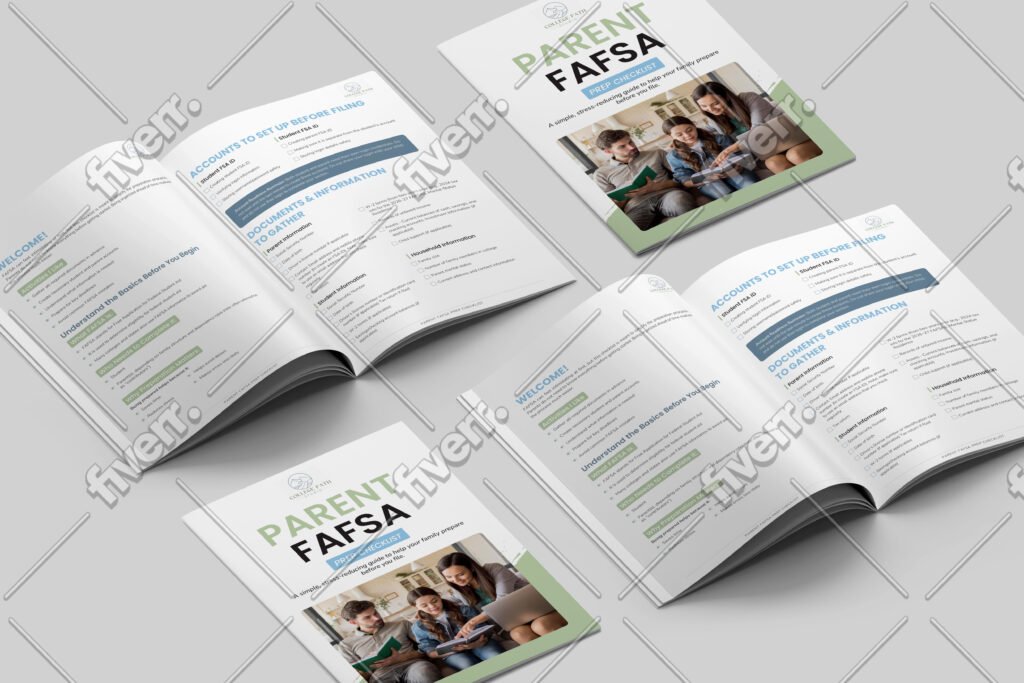
Want an easy way to stay organized during the FAFSA journey?
Grab our free Parent FAFSA Checklist now!
SECTION 3 – The “Future Me” Trap — 4 Mistakes to Avoid
When you are 18, “four years from now” feels like a lifetime away. This leads to what we call the “Future Me” trap—making choices today that your future self will have to work twice as hard to fix.
- Mistake #1: Borrowing for “The Experience”: Using loan money to pay for a luxury dorm or a high-end meal plan adds thousands to your debt for things you won’t remember in a decade.
- Mistake #2: Ignoring the Interest: If you have unsubsidized loans, try to pay just the interest ($15–$30 a month) while you are in school. This prevents your balance from “snowballing” before you even graduate.
- Mistake #3: Not Having “The Talk” Early: Many students wait until senior year to talk about money with their parents. Start these conversations now so you aren’t surprised by a bill you can’t pay in August.
- Mistake #4: Skipping the “Free Money” Search: Every scholarship you win is debt you don’t have to take on. Treat scholarship searching like a part-time job—it has the best hourly pay you’ll ever get.
SECTION 4 – Real Scenarios — Three Paths to a Degree
To see how these choices play out, let’s look at three different students.
Scenario A: The Strategic Transfer
- The Path: Two years at a local community college, then transferring to a state university.
- The Debt: $0 for the first two years (paid via part-time job), $15,000 for the final two years.
- The Result: A degree that looks identical to everyone else’s, but with a monthly payment that is less than a car note.
Scenario B: The Scholarship Hustler
- The Path: Attending a four-year university but spending 5 hours a week applying for local scholarships.
- The Debt: $25,000 in total federal loans.
- The Result: By winning $5,000 a year in small, local awards, this student cut their potential debt in half.
Scenario C: The “Dream School” at Any Cost
- The Path: Borrowing the full cost of an out-of-state private school using both federal and private loans.
- The Debt: $200,000 (50,000 per year).
- The Result: After graduation, this student owes over $2,00 a month. This makes it nearly impossible to move out, travel, or save for a house for the next 20 years.
Section 5: Student Finance FAQ
Q: Does having student debt ruin my credit score?
A: Actually, if you make your payments on time after graduation, student loans can help build your credit score. The danger only comes if you miss payments or default.
Q: What if I change my major?
A: This is one of the biggest hidden costs of college. Every extra semester you stay to finish new requirements is another semester of tuition and another round of loans. Try to do your “exploration” early through electives or internships.
Q: Can I pay my loans off early?
A: Yes! There is no penalty for paying off federal student loans early. Any extra money you pay goes toward the “principal” (the original amount you borrowed), which saves you massive amounts of interest over time.
Q: Is there any way to get loans forgiven?
A: There are programs like Public Service Loan Forgiveness (PSLF) for people who work in government jobs or for non-profits. However, these require 10 years of on-time payments, so they shouldn’t be your only plan.
FAST FACTS (from the US Federal Student Aid website)
- You can pick from repayment plans that base your monthly payment on your income or plans that give you a fixed monthly payment.
- Repayment plans based on your income are a smart choice to lower your payment. The lower your income—or the larger your family size—the less you’ll pay each month.
- If you don’t pick a repayment plan, your loan servicer will place you on the Standard Repayment Plan (a 10-year fixed payment repayment plan). This plan might result in a higher monthly payment for you.
A Final Word of Encouragement
We know this is heavy stuff. It feels like you’re being asked to make “adult” decisions before you’ve even walked at graduation. But remember: being aware of how this works puts you ahead of 90% of other students.
You don’t need to have every cent figured out today. You just need to commit to being a student of your own finances. You’ve got this, and we’re here to help you navigate every step of the path.